
Shuckstack Fire Tower Highlights
- Trail Features
Outstanding views, Wildflowers
- Trail Location
Fontana Village
- Roundtrip Length
7.0 Miles
- Elevation Gain (total)
2120 Feet
- Elevation Gain (per mile)
606 Feet
- Trail Difficulty
11.24
Strenuous
This strenuous hike is 7.0 miles roundtrip and includes 2120 feet of elevation gain.


Shuckstack Fire Tower Description
Fontana Dam has the distinction of being the highest dam east of the Rocky Mountains. Towering 480 feet in height, the dam backs water for 30 miles, and is a major source of energy for the Tennessee Valley. As you cross the dam, scan the mountains towards the north and you should be able to make out the Shuckstack Fire Tower in the distance.
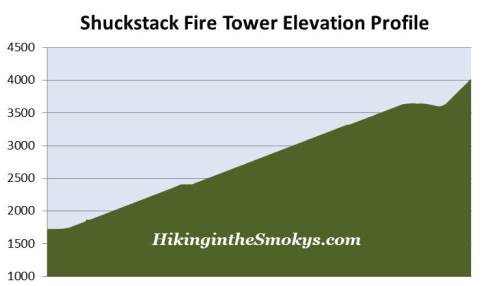
Once on the Appalachian Trail hikers will begin a fairly challenging ascent up an unnamed ridge. The trail climbs more than 2100 feet over the course of the next 3.5 miles, with much of that elevation gained during the first 2.4 miles.
At roughly 2.4 miles from the trailhead, just below the summit of Little Shuckstack, the path begins to level considerably, making your hike much easier over the course of the next two-thirds of a mile. At just over 3 miles, however, hikers will reach the steepest (but short) climb along the route. Shortly after ascending to the top of Twentymile Ridge you'll encounter a three-way intersection. The Appalachian Trail is marked with a simple white line blazed on the trees, while the path to the tower is marked with a white "T". Hikers should veer to the right here. The tower is only a tenth-of-a-mile from this junction.
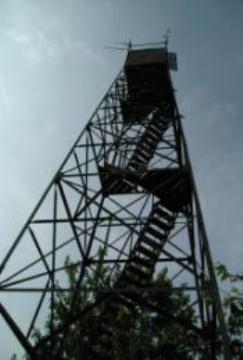
At the top of the mountain hikers will find the 60-foot fire tower, as well as the remnants of the one-room cabin where the lookouts stayed during their tours of duty. Constructed in 1934 by the Public Works Administration, the Shuckstack Fire Tower is actually a small wood and metal room, known as a cab, perched atop a winding staircase. The views from the bottom of the fire tower are now mostly blocked by trees. However, the views from the top are quite stunning. As you begin to climb the 78 stairs you'll likely notice that the tower moves ever so slightly, but don't be alarmed. Wind continuously blows across this ridge, and the tower is made to give a little. At the top you'll be rewarded with spectacular 360-degree views. The Unicoi Mountains can be seen towards the west, the Snowbird and Nantahala Mountains to the south, the Blue Ridge Mountains to the southeast, and the Great Smoky Mountains towards the east and north. You'll also be able to see Fontana Dam, as well as all of the terrain you covered on your way up to the tower.
The historic fire towers of the Great Smoky Mountains region were once used to gain a bird's eye view of the mountains in order to spot forest fires. Though many of the lookout towers have been removed as more modern methods of fire detection have been developed, Shuckstack and three other towers still remain within the national park.
There's some uncertainty about the future of the Shuckstack Lookout Tower, however. The source of this uncertainty stems from this statement made by park officials:
"Since the use of Shuckstack as part of the radio system has been discontinued, park management will need to make a decision about the need for and future of this tower."
Unfortunately the Shuckstack tower has fallen into disrepair in recent years. Several loose steps and a missing railing make the 60-foot climb a little frightening, and those who reach its top will find holes and a partially rotted floor. Obviously, the steel tower is in desperate need of restoration.
"Fire lookouts in North Carolina are a dying breed," says Peter Barr, author of Hiking North Carolina's Lookout Towers. "About a third of the lookouts that once stood in the state are gone. Others are so badly deteriorated that they face removal. Most people assume that the towers on public lands are still maintained; sadly, this is far from true."
If you're interested in learning more about the Shuckstack Fire Tower and the many other lookout towers in Western North Carolina, I highly recommend Mr. Barr's book.
Shuckstack Fire Tower Map
Shuckstack Fire Tower Elevation Profile
Directions to Trailhead:
The Shuckstack Fire Tower is located on the North Carolina side of the Smokies. From Bryson City, travel west on NC 28 to Fontana Dam. Drive across the dam, and then take a right at the fork, just past the dam. The trail to Shuckstack begins about 0.6 mile from the dam. To reach the Shuckstack Fire Tower you'll follow the Appalachian Trail as it heads north into the Great Smoky Mountains.